Monday, 25 November 2013

Angles


BLOG AND STUFF


Low angle 

These increase height (useful for short actors like Tom Cruise or James McAvoy) and give a sense of speeded motion. Low angles help give a sense of confusion to a viewer, of powerlessness within the action of a scene. The background of a low angle shot will tend to be just sky or ceiling, the lack of detail about the setting adding to the disorientation of the viewer. The added height of the object may make it inspire fear and insecurity in the viewer, who is psychologically dominated by the figure on the screen.


High angle


Not so extreme as a bird's eye view. The camera is elevated above the action using a crane to give a general overview. High angles make the object photographed seem smaller, and less significant (or scary). The object or character often gets swallowed up by their setting - they become part of a wider picture.


reverse POV


A point of view shot (also known as POV shot or a subjective camera) is a short film scene that shows what a character (the subject) is looking at (represented through the camera). It is usually established by being positioned between a shot of a character looking at something, and a shot showing the character's reaction (see  shot reverse shot ). The technique of POV is one of the foundations of film editing.


Pov

Both of these shots are POV shots that help show someones perspective, sometimes making scenes more tense as unlike other shots you can't see any of their surroundings. These are often used to show that someone is being watched or spied on. Sometimes a POV shot is done over the shoulder who remains visible on the screen, when a shot is taken over the shoulder a pull focus is used to make a certain subject seem more dramatic.


Eye Level

A fairly neutral shot; the camera is positioned as though it is a human actually observing a scene, so that eg actors' heads are on a level with the focus. The camera will be placed approximately five to six feet from the ground.


Birds eye view shot 
This shows a scene from directly overhead, a very unnatural and strange angle. Familiar objects viewed from this angle might seem totally unrecognisable at first (umbrellas in a crowd, dancers' legs). This shot does, however, put the audience in a godlike position, looking down on the action. People can be made to look insignificant, ant-like, part of a wider scheme of things. Hitchcock (and his admirers, like Brian de Palma) is fond of this style of shot.


Off Centre


The Dutch angle, also known as Dutch tilt, canted angle, oblique angle or German angle, is a type of camera shot where the camera is tilted off to one side so that the shot is composed with vertical lines at an angle to the side of the frame. In cinematography, the Dutch angle is one of many cinematic techniques often used to portray psychological uneasiness or tension in the subject being filmed. Many Dutch angles are static shots, but in a moving Dutch angle shot the camera can pivot, pan or track along the established diagonal axis for the shot. A Dutch angle differs from a high-angle shot and low-angle shot in that those refer to placement of the camera in height relative to the subject, which for human subjects is mostly defined by a person's eye-line. A special type of Dutch angle is the Bavarian angle, where the angle is changed by 90° from the common angle where horizontal lines become vertical.

Worms eye view

In cinematography a worm's-eye view is also useful in movie making. It is useful because it can be used as one of the camera shots/views. It is used in filming to look up to something to make an object look tall, strong and mighty.


Upside down 


This angle is used to give the viewer a disorientated feeling towards the scene also the point of view shot is used to make the viewer feel like they are there with the joker.


Centre
the centre angle is a fairly neutral angle to give the viewer a balanced shot and you can add on extra effects such as zoom effects ect. But they are mainly used in conversation shots as they are more static.


Side ways Shot
The shot is another used to disorientate the audience makes the scene more chaotic and distressed and in peril e.g. in gravity the use of side angle and upside down angle adds to the free flowing effect to the shot.


Thursday, 21 November 2013

Cables


Composite Video
(analogue)
Analogue transmission can carry standard definition and is used for formats such as NTSC, PAL and SECAM. It also only carries 1 signal, unlike S-Video or Component. They are used for appliances like VHS and old games consoles.

DVI Cable
(digital)
DVI is a digital cable, meaning no loss in quality. It is also often found on HDTVs and Video cards. There are three main types of DVI cables; (DVI-I, DVI-A and DVI-I.) The cable comes in single and dual link and has a resolution of up to 3840x2400 but there is no audio.


HDMI
(digital)
HDMI is used on many different devices ranging from computers, cameras, monitors, and blu-ray players. HDMI is a single cable that carries video and audio signals digitally, meaning no loss of signal.
Version 1.0 allowed for 1920x1080p
Version 1.4 supports ethernet, 3D and 3840x2160p at 30fps
Version 2.0 supports 3840x2160 at 60fps

S-Video
(analogue)
Analogue cable carrying standard definition (480i and 576i.) Separates black and white colour signals, achieving a better image than composite, but lower resolution than component video. Each pin has its own ground pin (fifth, bottom pin is for holding purposes.)


Component Video
(analogue)
RGB distributes the colour signal three ways (red, green, blue.) It allows for full HD resolution, however due to the nature of digital TV's, extra conversion must take place therefore creating artifacts (edge clarity.) Not all HD sources support progressive output, so it may be limited to 1080i.

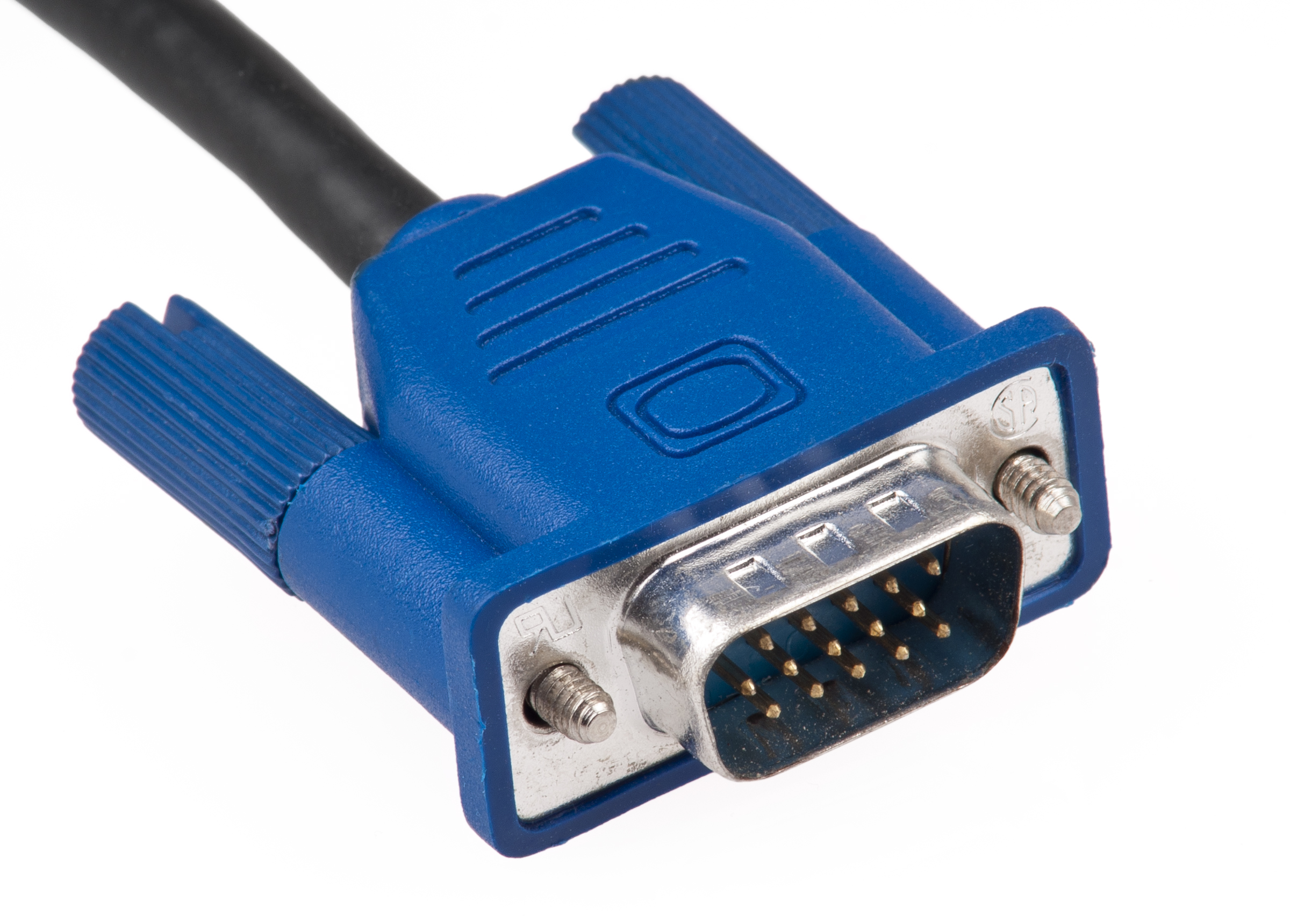
VGA
(analogue)

A VGA cable is typically used for computer monitors and connects to video cards, HDTVs. Laptops, Netbooks and an array of other equipment. A VGA cable uses the same RGB method as a component cable and also allows higher resolutions ranging from 640x400 all the way up to 2048x1536. The higher resolution cables normally require coaxial wiring or insulation to create the higer quality image. Even though it can have a higher resolution the VGA cable does not carry audio
.

RCA Connector
(analogue)

An RCA cable is used to carry audio and video signals and it is primarily used for stereo equipment, often consumer grade. It is still used by many devices before and after the digital switchover (VHS,DVD players and TVs) The RCA cable can lose quality over the distance and is also susceptible to hum and noise.

1/4 and 1/8 Jack (3.5mm)
(phone connector - analogue)

The 3.5mm is found on phones, DSLRs and other mp3 enabled devices and is intended for short runs whilst a 1/4 jack is used for stereo equipment, guitar and bass leads. 

XLR Connector
(digital)

This is the most common cable that is used for microphones. It has 3 pins, similar to the blanced connection on a 3.5mm or a 1/4 jack. The female end is usually the source and the male is the input. Also because of the design a microphone cable will not disconnect on its own accord.


Monday, 18 November 2013

An Idiots Guide

An Idiot's Guide to Final Cut Pro

Folders

First you have to make a folder so you know where your work is saved. Any additional work should also be put in this video. To create a folder that you can easily find, you should put the folder on the desktop so it s always visible when you close everything. When creating a folder you should name it something related to the project so you know what you are looking for.


After making the folder you can just drag and drop the files into the folder. These files can now be accessed whenever you are logged on tot he mac. 


Scratch Disks

Setting scratch disks on Final Cut Pro is an important part of the editing process. A scratch disk determines where any footage captured will be stored, including rendered files, waveform, cache and autosaves. 

Project and Sequences


In one project there can be many different sequences. These sequences are the parts of the project you are editing. Sequences relate to the timline you are working from, this is useful when creating rushes to preview footage and recieve feedback. 


Exporting

Exporting footage means that the project will become one whole clip that is binded together and cannot be changed. In Final Cut Pro, clips are normally exported as quick time movies but you can decide which format they are exported in if the client wants it for mobile viewing, web use, DVD or even uncompressed for a high quality video. To chose the different formats the video must be exported using Quick Time Conversion. This allows you to chose the file format, the resolution it is exported in and the quality of the finished product.


Log and Transfer


Log and transfer is used when importing footage because it may need a format change before it is used. When using a Panasonic camera, the recorded footage is in a different format and compressed after recording by using the log and transfer it changes this format to a .MOV file which is used when editing and can also be used on any computer. The DSLR cameras record in .MOV but the log and transfer is still used. 


Basic Editing


The razor blade tool is used to cut the different clips to make moving them about easier and also to cut off and delete unwanted parts. When cutting parts of a clip it allows the editor can move that piece of clip around the timeline or delete it, it also allows the editor to add separate effects or transitions to that part of clip. 


This is how to cross fade to a different clip. This is a basic transition because it is very simple to use but can be very effective. When using a cross fade while one clip is selected it is added to either end of the clip (beginning and end). 

Tuesday, 15 October 2013

Unit 38 Sound Production For The Moving Image

What is diagetic and Non-Diagetic sound?

Diagetic sound is the sound that is made by people or objects that are on the scene at that point whilst non-diagetic sound is the sound that is made by other objets that are not on scene or they are a voice in someone's head. It can also be the sound of others having a conversation off screen. The distinction between diegetic or non-diegetic sound depends on our understanding of the conventions of film viewing and listening.  We know of that certain sounds are represented as coming from the story world, while others are  represented as coming from outside the space of the story events.  A play with diegetic and non-diegetic conventions can be used to create ambiguity (horror), or to surprise the audience (comedy). 


What is a character motif?

A character motif is a piece of music set with a character, for example in Jaws when the suspensive music comes on that means that Jaws is coming. The character motif is also diagetic because it shows that this character is in scene. The mood of the music can  determine what is going to happen or what has happened. This is also used to create dramatic irony and to show the audience that something is going to happen when the characters have no idea.

What is juxtaposing in a movie?

Juxtaposing in a movie is when something bad happens but there is a happy type of soundtrack in the background. For example if someone were to be stabbed in a film there might be a jolly soundtrack in the background.

How it affects the mood and meaning.

The soundtrack sound can affect the mood because it can change how people think about what is happening in the shot. It can change the mood depending on what key the track is in, for example if it is in a minor key then it can be mysterious or make the shot look scary but if it is in a major key then it can make the piece jolly or uplifting. It also affects the meaning because the protagonist could be out of sight but the music determines what they are doing whilst they are out of shot. 


Exercise

In this exercise we are creating Foley sound for a clip. The clip we are doing is The Wiley Coyote. We need to create the sounds that would fit with the clip. If we cannot create a noise that is needed then we will find the noise in the internet and then put the source on to the evaluation. To create these noises we will find objects that will help to create noise (e.g Throwing something off a desk to create the crashing noise of the utensils being thrown off the table) Most of the sounds will be fairly easy to create but if we can not find them then we can use either iMovie or YouTube to get the noises.

Evaluation 

http://youtu.be/z6ldWszaMiU

I think the foley sound we made for the clip enhanced the viewing experience and added an effect towards the viewers thoughts. Creating the sound wasn't an easy task because the wind was blocking out the sound we were trying to make when outside, this caused a problem because we could not create a different sound when rolling something down the hill. This was also a problem because we had to make every noise on a hard surface and in a echoed environment.This was a problem because the hard surfaces created a louder effect and not a muffled sound like something hitting the dirt. The sounds we needed which were created on the hard surfaces were our only option because there was too much wind outside to record without picking up the noise.  This wasn't something we could change because there was not a lot of choice when it came to locations in the college. If i could change something about the video it would be the crashing noises at the end of the video because it was too echoey and it didn't last long enough. The soundtrack we used was Comic Bouncy (instrumental).

Monday, 7 October 2013

Unit 21 - Production Equipment


History of Cameras


The first video camera was designed by Louis Le Prince in 1888. In 1923 Eastman Kodak introduced a 16mm film stock, principally as a lower cost alternative to 35mm and several camera makers launched models to take advantage of the new market of amateur movie-makers. Thought initially to be of inferior quality to 35mm, 16mm cameras continue to be manufactured today by the likes of Bolex, Arri and Aaton many in the Super 16mm and Ultra 16mm formats.
Video Cameras create the illusion of motion because it is 24 images a second. These motion picture cameras are capable of high speed image capturing. The Film is inside the camera is completely dark then the shutter opens and the sensor is exposed to the light which it then takes in the shadows of the image and imprints them onto the film. Finally the shutter closes and the next piece of unexposed film moves into places.  

Camera


There are three different things that can effect the exposure of an image. The aperture changes the amount of light that the camera takes in and also controls the Depth of Field. The DOF defines the objects that ill be focused on, for example if an object is further away within the depth of field then it will be blurred if the camera is focused on the nearer objects.  The smoothness of a film all depends on the shutter speed. This is because the shutter speed defines how fast a video or image will be captured. The ISO measures the sensitivity of the image sensor. The same principles apply as in film photography – the lower the number the less sensitive your camera is to light and the finer the grain. Higher ISO settings are generally used in darker situations to get faster shutter speeds (for example an indoor sports event when you want to freeze the action in lower light) 


Lighting


The different types of lighting include;

The Key Light- This light is the main light and used for every production. 
The Backlight- This light is at the back of the subject and stops any shadows that are created by the Key Light. Using lights of different colour temperatures can create a great effect. This simply means using different lights of different colour in the same shot. This was used to great effect by James Cameron in the Steel Mill scene of "Terminator 2", in which he used blue and orange lighting (motivated by the moonlight and the molten steel respectively). 
Another great use of lighting is also in Great Encounters of the Third Kind when the aliens are coming out of the ship the light blinds the characters and keeps the aliens a foggy mystery.

Sound

Shotgun microphones are very directional and are more accurate when recording sound because of that. They can have covers but on them which prevent the wind from getting into the mic and been recorded. The shotgun microphones are very useful when used for wildlife as they are directional.

. 

There are many different microphones on the market. They range massively in their quality and price. Many hundreds of pounds are needed for a very high quality microphone. We don't have that kind of money. You can just use the ZOOM's inbuilt microphones or you can purchase a range of medium-priced microphones that will jack into it. 


Some microphones are sold which will fit onto your camera's hot-shoe. I have used these and they are no good. They pick up your breathing and the noise of your fingers on the camera.
However, they are still good low priced microphones and can be used by adapting them to fit a boom pole. The pole telescopes out, is lightweight and allows someone to hold the microphone very close to the actors. Part of the pole has a foam wrap so the boom handler grips it there and doesn't transmit his hand sounds along the pole and into the microphone.

Production Video Evaluation


http://youtu.be/_wsm2q5vvmg


In our group we made a video about production gear. This video is informative because it tells the viewer about lighting, cameras and sound. It also shows the viewer how to set up a shotgun mic onto a boom pole. The video could have had some more examples of how to use the equipment and also have some better explanations of the equipment. However the Editing, Directing and Production itself was all done well. 


The acting could have been improved if there was more enthusiasm and someone else should have done the acting. The audio could've been made louder because it cannot be heard when there is background noise. The transitions were badly made because there were black areas before and after the transition. If i could make it different i would get a different actor and change some of the transitions & noise.